

Finding Visionary Managers
Moonshot-funding groups know vision is the core job requirement


What type of people back big futuristic visions? More specifically, what type of people should government agencies and other organizations that want moonshots and paradigm-shifting breakthroughs hire? Who are the people they need to find?
Those who have a futuristic vision.
Not your standard Program Manager
Consider this job posting from DARPA – the Pentagon’s agency for high risk, high reward work – that we found published in The Economist in 2009:
Are you a scientist or engineer with a radical idea (or ideas) that you believe could provide meaningful change of lasting benefit for the U.S. military? Would you like to lead the country’s most capable academic and industrial experts to make that idea become reality in a period of just a few years? If so, you should consider joining the Defense Advanced Research Projects Agency (DARPA) as a program manager.
What is a DARPA PM? A DARPA program manager is…
An idea generator
A technical expert
An entrepreneur
A visionary
A patriot dedicated to national service
Would you apply? This job ad is unusual in that it was paid and placed in a non-military publication. The Economist is a weekly magazine covering current affairs and business news globally, where you more often see job postings for diplomats, policy wonks, and various global positions. Here was DARPA casting its net widely and broadly to find those outside its usual recruiting circles.
Now look at the job wording more closely. We love that the first line is a direct invitation to a “scientist or engineer”. DARPA relies on people with deep expertise and technical knowledge, who often live in the messy world of R&D or cutting-edge discovery, so already DARPA has clarified its target candidate.
The next part of the sentence is revealing too: “with a radical idea (or ideas).” This person should have a crazy vision, preferably even more than one, for DARPA. Moreover, the following phrase “that you could believe could provide meaningful change of lasting benefit” shows that DARPA pursues people who aim to make a real, big difference. And that they need to deliver in a tight time frame – often four years or less as a government employee.
Now jump down a few lines to what DARPA calls these people: program managers or PMs. This job title may sound generic, even mild, yet DARPA is quick to offer five other hats that the PM wears from “idea generator” to “visionary”.
These PMs bring more than money; they bring a grander sense of what could be. They find and invest in others to expand on a shared dream and make that dream possible. And from our experience, these people often bring a healthy disrespect for unnecessary procedure too.
ARPA-inspired PMs start with vision
A growing number of governments view DARPA as the gold standard. A mix of organizational elements, well documented, show why DARPA has been an enduring role model since 1958. However, groups that follow this ARPA model today often miss how the PM role really functions.
In an early study of DARPA, Tamara spoke with several dozen PMs to learn about their culture, beliefs, and practices (see her ARPA writings here). DARPA defined the PM’s responsibilities in sweeping terms in an internal job description from 2010: “Defines, develops, and communicates a vision and execution plan to incorporate technologies into [the target] program area.” The job req also stated the need for “exceptional technical ability and seasoned judgment” in a PM.
In practice, DARPA pioneered a vision, a checkbook, and a plane ticket setup in its PM role. Each PM brings a vision of a grand, even futuristic, idea; the check book is their funding support for taking a big bet, and the plane ticket signifies their willingness to get out in the field, meeting the builders and performers (i.e., the teams making the idea real) wherever they may be. Yet we don’t see these practices enough from groups who say they are serious about building moonshot capability.
American funding agencies, such as ARPA-E (the teenager) and ARPA-H (the baby), have modeled their PM role after DARPA (the grandaddy). Their PM roles continue to emphasize vision. In Europe, the European Innovation Council (EIC) announced that it is recruiting six new PMs for 2026 to shape Europe’s portfolio of high-potential projects. We are glad to see the spirit of the ARPA model captured in the latest EIC description, which places the ability of “developing visions” at the forefront:
EIC Programme Managers are responsible for developing visions for technological and innovation breakthroughs, the active management of portfolios of EIC funded projects to support these visions, and bringing together stakeholders to put these visions into reality.
Other agencies worldwide, like KARPA (in South Korea) and SPRIN-D (Germany), are still finding their footing and talent focus.
How Alphabet’s X finds category-creating PMs in industry
Companies also seek visionary program managers. Take Alphabet’s X, The Moonshot Factory, which has an ARPA-like sensibility aiming to “bring sci-fi ideas into reality to help solve some of the world’s hardest problems.” Although X is not directly built on the ARPA model, this business unit seeks similar moonshot results.
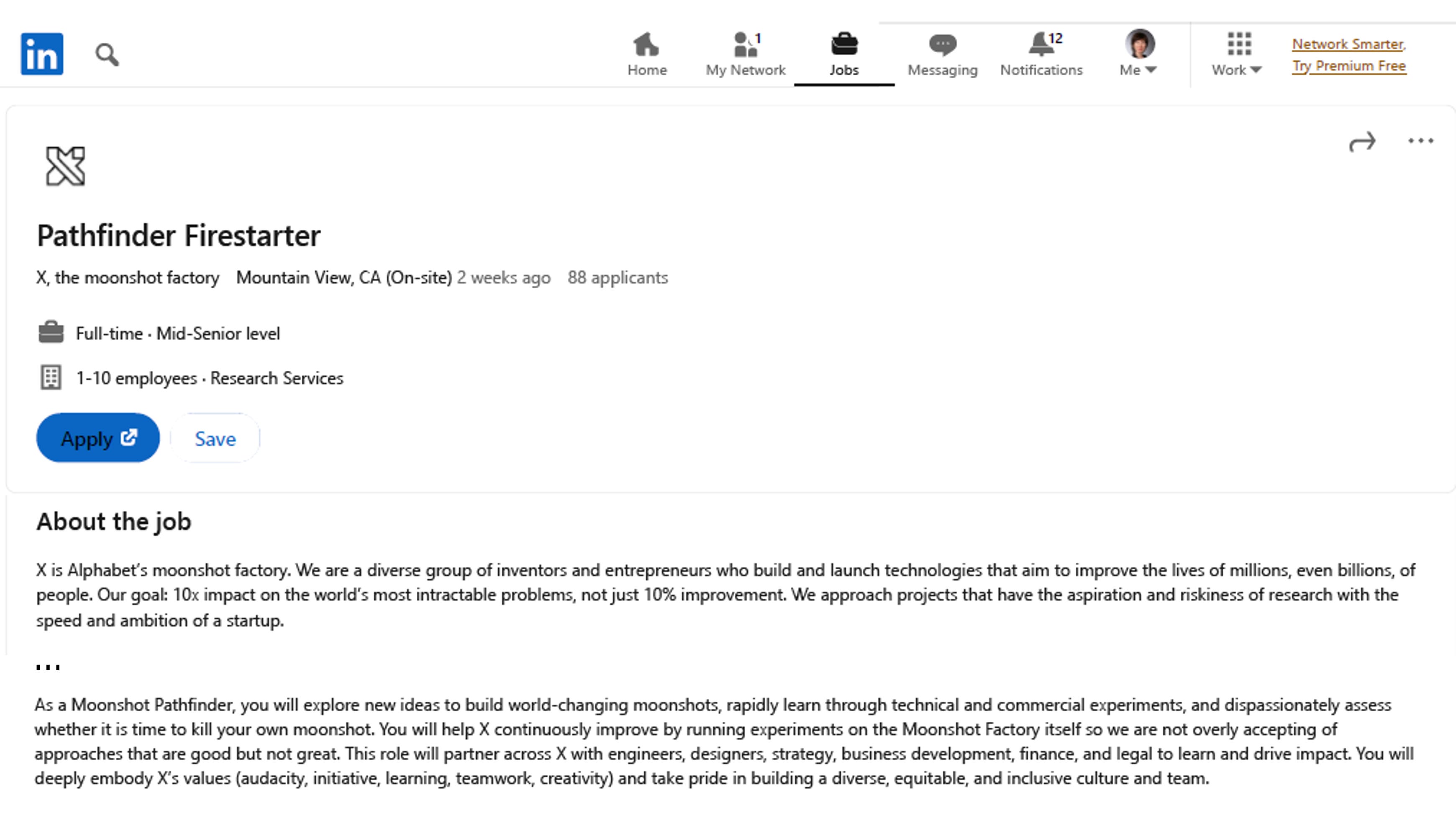
Over the years, X has advertised jobs online with unusual titles. X’s Pathfinder Firestarter role was defined by “How You Will Make 10x Impact”, and job responsibilities included:
Generate moonshot scale ideas from external and internal sources
Craft the strategic vision and learning plan to de-risk the technical, commercial, and product aspects of the idea
Be audacious, take initiative, and creative while remaining humble and supportive of teammates
Obvious know-how, right?
Similarly, the Moonshot and Technology Prospector job at X expected a candidate to “Select, advocate for and manage the execution of promising outsourced directed research and present proposals internally to gather talent and support.” A preferred job qualification was “experience in intersectional and lateral thinking” too.
Turning imagination into action
The announcement of the new EIC PMs was refreshing because we recently met with a government director leading a new groundbreaking effort for his nation, a wonderful person who was the opposite of a DARPA PM. He was a “lifer” employee, stuck in endless office meetings, with no strong vision yet for his program – or the realization to step forward and enlist friendly help to co-develop the missing vision and related ecosystem. Partly because… we could go on.
The point is that visionary PMs start with imagination and then work to turn that imagination into action. This focus on vision is essential in developing the kind of ecosystem needed to deliver radical innovation. These visionary PMs stand alongside ambitious researchers who deliver experimental results, alongside inventive engineers whose tinkering turns those results into scalable solutions, and alongside technically-savvy entrepreneurs and product managers who define and build new markets for those new solutions.
PMs are prime movers who spark the process.
Understanding the true nature of the visionary PM role raises all sorts of other considerations. Such as, where can groups find people with these wild abilities? Can older “operators” develop a moonshot mindset and capability? And why aren’t we teaching more of these skills in high school – or frankly, even earlier to teenagers?
Let us know which specific topic or angle you wish to hear more on, as this thread is always top of mind for us!
Reach us any time at hello@buildingmoonshots.com. (Tamara reads every email.)
GET THE SOURCE
🚀Get your copy of Building Moonshots

Building Moonshots is your handbook for the almost impossible, describing over fifty ways for building big ideas with big impact. Financial Times describes this book as “easily digestible” with “practical insights for extraordinary entrepreneurship”.
SPECIAL BOOK BONUS
💫 Download your free poster of all 50+ Moonshot Ways
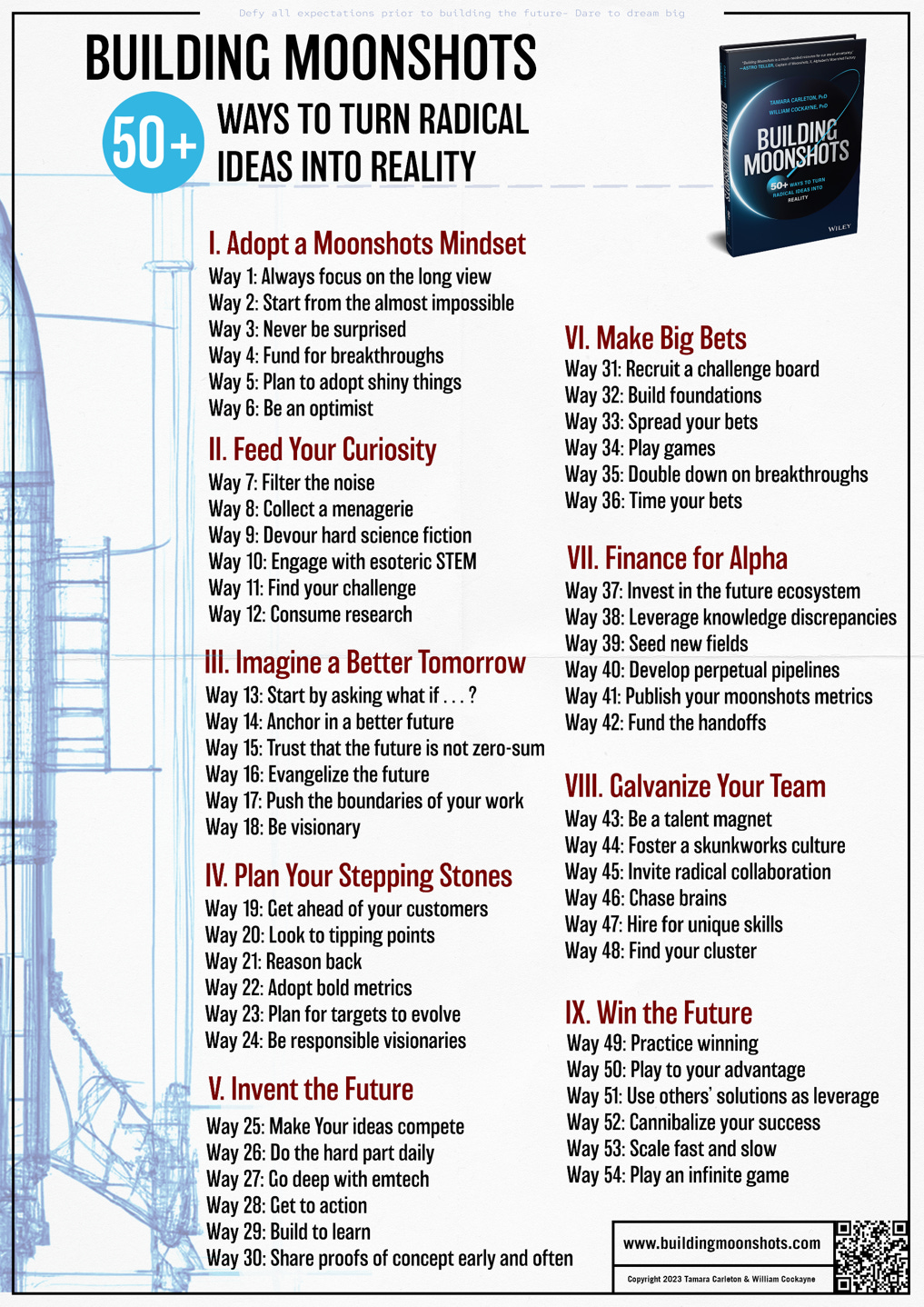
Download a free poster showing all 50+ Moonshot Ways that you can display as personal inspiration, team reminder, or cultural invective.
(print it big on US 11x17 or A3 sized paper)
OLDIE BUT GOODIE
📘Download your free copy of the seminal Foresight Playbook

If you haven’t yet, also download your free copy of the playbook that started it all: our Playbook for Strategic Foresight and Innovation. Developed from the first decade of courses, research, and insights from Stanford’s University Foresight program, and generously sponsored by the government of Finland’s innovation agency, these foresight tools and mindsets are easy to adopt, quick to apply, and used in thousands of the world’s leading innovation-seeking organizations. (Look for new playbooklets later in 2024!)